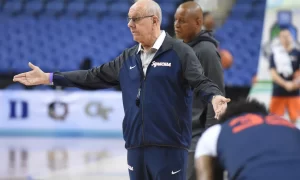

In his 47 years at the helm, Jim Boeheim could be described as many things: a loyal lifer, a defensive mastermind, and at times the most stubborn man in Central New York.
It was Boeheim who transcended Syracuse, turning the Orange from an independent afterthought to a force to be reckoned with in the Big East golden years. During his tenure, Cuse reached the tournament 35 times, the Final Four five times, and were crowned champions in 2003 with the help of a guy named Carmelo Anthony.
Jim Boeheim arrived at Syracuse in 1962, and by the time he took over the program in 1976, he’d already spent half his life inside its walls. He stepped into the job during Gerald Ford’s presidency and coached his final game in 2023 with fellow Cuse-grad Joe Biden in office.
Through all of that, he was unapologetically unique. Boeheim was blunt, no-nonsense, and often unwilling to sugarcoat anything. For many, his coaching style fit with the identity of Syracuse and the level of toughness needed to win in an older, grittier era of college basketball.
But while that approach gave Syracuse an edge, it eventually hardened into stubbornness. Over time, Boeheim’s rigidity in his rotations, recruiting, and even his public comments cost Syracuse opportunities, even with top recruits.
In 1995, Stephon Marbury, who was viewed as one of the best high-school point guards ever, was drawn to Cuse from a young age. In a recent podcast with Carmelo Anthony, Marbury recalled that he “was going to Syracuse before Syracuse knew [he] was going to Syracuse.”
“Playing in the Carrier Dome, that’s what I was foreseeing as a kid. You see Pearl [Washington] shaking and baking, you gotta be in that building,” he said.
But Marbury’s excitement quickly faded when Jim Boeheim met with him and his family on a home visit. As Marbury recalls, “Five minutes in, [Boeheim] comes out and says, ‘you are not going to start.’ I was like, ‘that’s the end of that… It broke my heart.’”
Just days later, Marbury signed with Georgia Tech, where he was guaranteed a spot in the starting five as a freshman. He went on to average 19 points per game that season, while Syracuse fell to Kentucky 76-67 in the championship game — a “what if” moment that still resonates in the program’s history.
Boeheim’s blunt, no-nonsense style built toughness, loyalty, and a winning culture, but it could also push away even the most talented players and create tension from within the program.
In Marbury’s case, the same edge that made him legendary ended up keeping a generational talent from Syracuse. What makes this story so telling is how it highlights the double-edged nature of Boeheim’s personality — the very traits that inspired devotion and produced wins could also create missed opportunities. For every Carmelo Anthony who thrived under his system, there were moments like Marbury’s visit that remind us even the most iconic coaches have flaws that shape their legacy.