
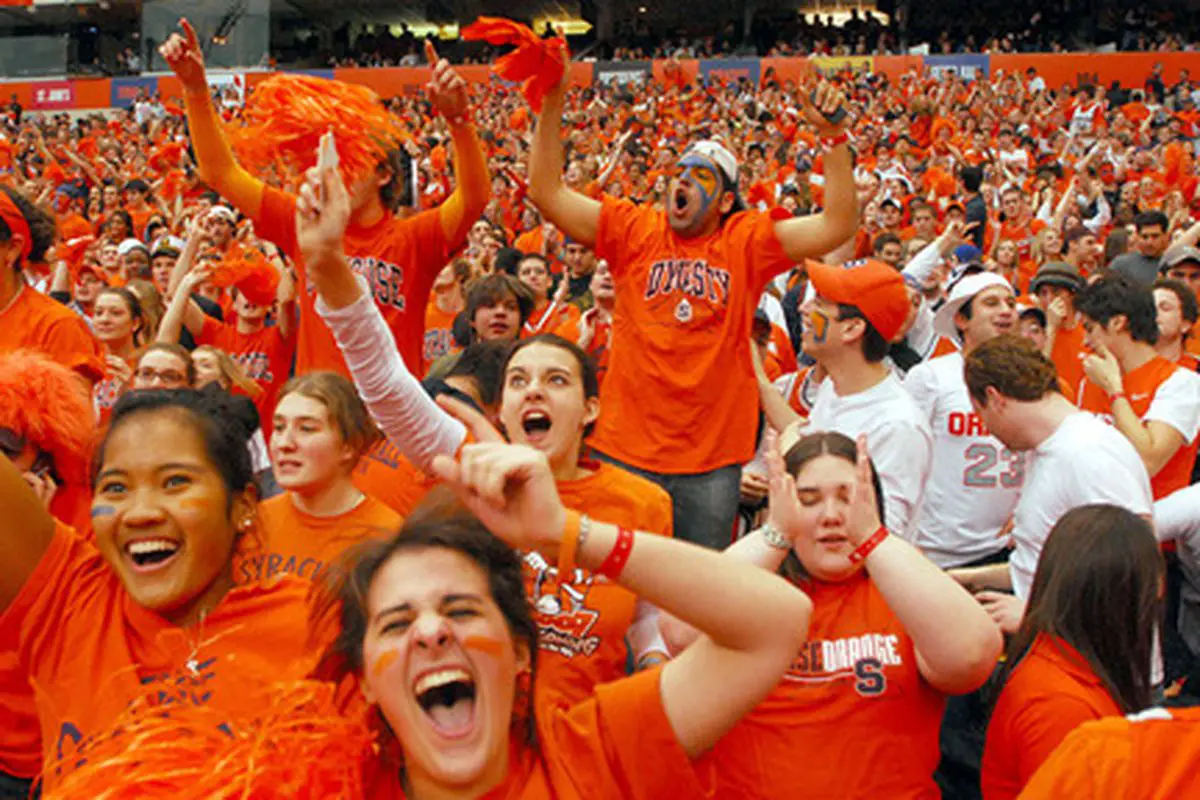
If you grew up in Central New York, “Orange” isn’t just a color; it’s a lifestyle. We bleed it. From the raucous atmosphere of the JMA Wireless Dome to the quiet pride of wearing a navy-and-orange cap in the middle of a snowy January, the identity of Syracuse is inseparable from its vibrant hue. But as a lifelong sports geek living right here in the heart of Salt City, I recently started wondering: why are we like this?
I dug into the archives and found that Syracuse University actually pioneered this look. Back in 1890, the school officially adopted orange to stand out, becoming the first university in the country to use a single, bold color. Before that, the school experimented with pink and green—could you imagine the “Pink and Green Men” on the basketball court? Thankfully, the desire for a unique, confident, and bold identity won out. Because no other school was using it at the time, Syracuse staked its claim on orange to symbolize a fearless spirit.
However, while we might feel like we own the color in the 315 area code, the rest of the world has some pretty legendary “Orange” teams of its own. If you’re looking to diversify your sports palette, here is a beginner’s guide to the global teams that share our Syracuse spirit.
The “Oranje” Revolution: Netherlands National Football
If there is one team that defines the color orange on the global stage more than Syracuse, it is the Netherlands national football team. Affectionately known as Oranje, the Dutch national team is a powerhouse of European soccer. Their use of the color stems from the House of Orange-Nassau, the Dutch royal family.
When you watch the Dutch play, you aren’t just watching a game; you’re watching a philosophy. In the 1970s, they pioneered “Total Football,” a tactical system where any player could take over the role of any other teammate on the pitch. Led by the legendary Johan Cruyff, they became the most stylish team in the world. Even today, walking into a stadium where the Dutch are playing is like walking into a sea of orange fire. For a Syracuse fan, it feels surprisingly like home, just with more singing and a different kind of football.
High-Speed Papaya: McLaren Racing in Formula 1
If your passion for sports leans more toward 200 mph straightaways than halftime shows, you need to look at Formula 1. Specifically, look at McLaren. While many F1 teams change their liveries to suit sponsors, McLaren has returned to its roots with a striking “Papaya Orange.”
The color was first introduced by the team’s founder, Bruce McLaren, in the late 1960s. Much like Syracuse’s decision in 1890, Bruce chose Papaya because it stood out on the black-and-white television broadcasts of the era. In the 2024 and 2025 seasons, McLaren has surged back to the front of the grid, with drivers Lando Norris and Oscar Piastri taking the fight to giants like Red Bull and Ferrari. Watching a Papaya Orange car zip through the streets of Monaco or under the lights of Las Vegas is a reminder that orange is truly the color of speed and ambition.
From Valencia to Blackpool: Orange in Club Soccer
Beyond national teams, several iconic clubs across Europe have embraced the orange identity. In Spain, there is Valencia CF. Known as Los Ches, they often feature orange in their kits to celebrate the famous oranges grown in their region. They are one of the most decorated clubs in Spanish history, and their stadium, the Mestalla, is one of the most intimidating places to play in Europe.
Then there is Blackpool FC in England, nicknamed “The Tangerines.” They are a historic club with a cult following. For a Syracuse fan, seeing a small seaside town in England rally around a bright tangerine jersey feels very familiar. These clubs prove that whether you are in the Mediterranean or the North of England, orange remains a symbol of the underdog who isn’t afraid to be loud.
Digital Fire: The Orange Power of Esports
Even in the modern world of competitive gaming, orange remains a dominant force. If you follow esports, you’ve likely seen the logo of Fnatic. One of the oldest and most successful esports organizations in the world, Fnatic uses a sleek orange-and-black aesthetic.
Whether they are competing in League of Legends, VALORANT, or Counter-Strike, Fnatic represents the same boldness that Syracuse sought in 1890. In the digital arena, where branding is everything, orange is used to signify energy, creativity, and a bit of a “disruptor” mentality. It’s the color of the new guard taking over the world.
A Global Connection Beyond the Dome
Exploring these teams has made me realize that being an “Orange” fan is a global fraternity. Whether it’s a Dutch fan in Amsterdam, a racing enthusiast in a McLaren garage, or a student at Syracuse, we all share a love for a color that refuses to be ignored. This boldness often translates into a love for high-stakes excitement.
In many international sports circles, fans look for ways to keep the adrenaline going during the off-season or halftime. In some cultures, this includes engaging with traditional games of strategy and luck. For instance, while waiting for the next big match, some enthusiasts might enjoy a quick round of Sic bo, a classic game that captures that same “bold choice” spirit we love in sports.
In the end, our Syracuse identity is just one part of a much larger, vibrant tapestry. The next time you put on your favorite orange hoodie, remember that you aren’t just representing CNY——you are part of a global legacy of boldness. Whether it’s on the pitch, the track, or the court, orange will always be the color that stands out from the crowd.